DOCSIS 4.0 Can Now Push Cable Networks to 25 Gbps Without Replacing Coax
Cable has spent years being told fiber would eventually replace it. CableLabs’ latest answer appears to be: not quite yet.
A new optional DOCSIS 4.0 specification can push hybrid fiber-coaxial networks toward 25 Gbps of downstream capacity while keeping coax in the last mile.
Instead of digging up neighborhoods and replacing every cable running to a home, operators could squeeze considerably more capacity through infrastructure already hanging on poles, sitting underground, and disappearing into walls.
Twenty-five gigabits per second is an attention-grabbing number. More interesting, though, is what cable operators might need to change before they can actually use it.
Coax Just Got Another Extension on Its Retirement Date
CableLabs has published physical-layer specifications for an optional DOCSIS 4.0 annex capable of supporting up to 25 Gbps downstream across 3 GHz of spectrum.
Publication came roughly a year after the project was first announced, moving 3 GHz DOCSIS another step closer to something equipment manufacturers can actually build around.
Scale becomes easier to appreciate beside previous generations.
DOCSIS 3.1 supports network capacity of up to 10 Gbps downstream and 1 Gbps upstream. DOCSIS 4.0 has already gone considerably further in testing.
CableLabs has demonstrated 18 Gbps of downstream capacity across a service group, with two modems each receiving roughly 9 Gbps. More recent interoperability testing has produced downstream performance near 14 Gbps using current DOCSIS 4.0 technology.
Now 25 Gbps sits on the roadmap.
One distinction matters before anyone starts imagining a 25 Gbps speed test glowing on every living-room router. That figure represents capacity available across part of the cable network, not a dedicated 25 Gbps residential connection for each customer.
Capacity gets shared among subscribers connected to a service group. Operators can use additional capacity to support faster tiers, more customers, heavier traffic, or some combination of all three.
Across OpenVault’s dataset, average monthly broadband usage reached 711 GB per subscriber in Q2 2026, up 7.1% in a year. Subscribers using at least 2 TB a month accounted for 5.86%. A 25 Gbps ceiling sounds excessive right up until customers keep finding new ways to fill the pipe.
Still, going 2.5 times past DOCSIS 3.1’s maximum downstream capacity without replacing coax is not a minor adjustment. Cable keeps finding ways to make retirement paperwork surprisingly complicated.
More Spectrum Is Doing the Heavy Lifting
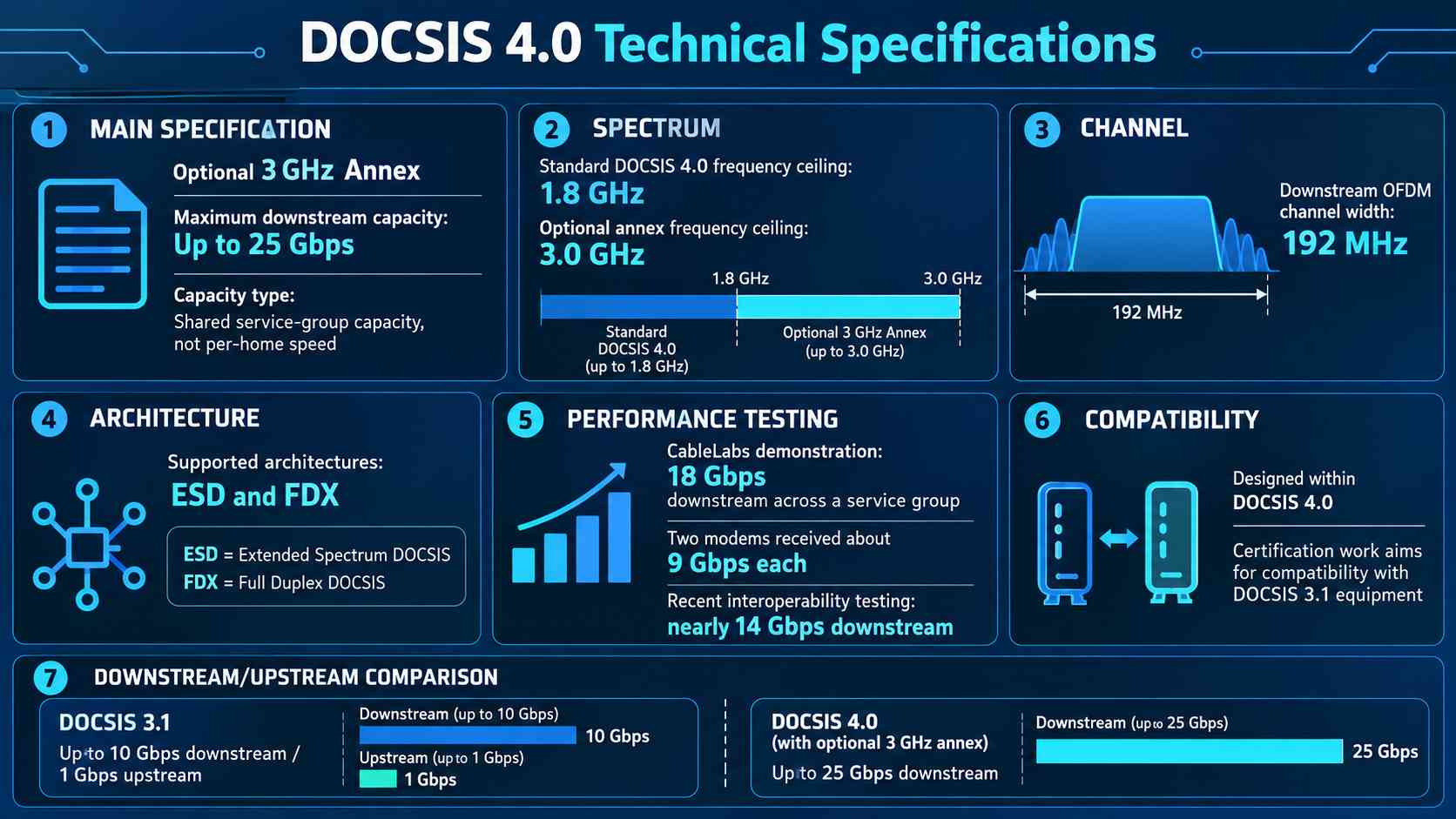
Standard DOCSIS 4.0 operates at frequencies reaching 1.8 GHz. CableLabs’ optional annex stretches that ceiling to 3 GHz.
Extra spectrum is where much of the added capacity comes into play.
Instead of creating an entirely new DOCSIS generation, CableLabs kept the 3 GHz specification inside DOCSIS 4.0. Existing 192 MHz-wide OFDM downstream channels are still part of the design, and both major DOCSIS 4.0 architectures are supported.
Extended Spectrum DOCSIS, usually called ESD, increases usable spectrum across an HFC network. Full Duplex DOCSIS, or FDX, lets upstream and downstream traffic use overlapping spectrum in parts of the network.
Both approaches are intended to extract much more performance out of coax already installed between neighborhood infrastructure and customer premises.
That part is economically important.
Replacing coax with fiber-to-the-premises can deliver huge capacity, but construction is expensive, disruptive, and slow. Streets may need digging. Properties need new drops. Crews need access to buildings. Every meter of infrastructure becomes another item on somebody’s spreadsheet.
A 2025 U.S. deployment study put median construction cost at $18 per foot underground and $8 per foot aerial, with 92% of respondents reporting higher costs during the year. At neighborhood scale, those feet become miles surprisingly quickly.
Squeezing more capacity out of coax is not a small-market trick. It is an infrastructure decision measured across most of the country.
Twenty-five gigabits sounds impressive. A network operator may care even more about how many extra years of useful life that 25 Gbps could buy.
“Keep the Coax” Does Not Mean “Change Nothing”
Nobody should read 25 Gbps over existing coax as 25 Gbps over an untouched cable network.
Moving HFC systems toward 3 GHz introduces some fairly stubborn engineering problems.
Higher frequencies behave differently across coaxial networks. Signal loss increases, amplifier requirements change, and equipment that worked perfectly well at lower frequencies may suddenly become the networking equivalent of an employee being told the job description has doubled.
CableLabs is studying amplifier spacing as one of the major challenges. Operators may need shorter distances between amplifiers, extra booster amplifiers, or redesigned equipment capable of maintaining usable signal quality across higher frequencies.
Power requirements also become part of the problem.
More active equipment can mean more power consumption and more complicated upgrades across networks containing enormous numbers of physical components.
Amplifiers are only part of that inventory.
Taps, splitters, connectors, optical nodes, remote PHY hardware, and cable modems all need to function at frequencies reaching 3 GHz if operators want to take full advantage of the specification.
Scale quickly gets uncomfortable.
Roughly 45 million cable taps are estimated to exist across the United States alone. Replacing even a portion of that inventory turns a technical upgrade into a substantial logistics project.
Industry planners have already started accounting for that possibility. Three-gigahertz-compatible tap housings have been standardized so equipment installed during current maintenance work can support future upgrades.
That is a small detail until it gets multiplied across tens of millions of pieces of hardware.
So yes, the coax can stay. Some equipment attached to it may be quietly updating its résumé.
Economics May Decide How Far 3 GHz DOCSIS Goes
Raw bandwidth is only half the story.
Cable operators already have enormous amounts of money invested in HFC networks. Keeping those networks productive for another upgrade cycle could delay expensive fiber-to-the-premises construction in areas where 3 GHz DOCSIS provides enough capacity.
Interoperability could make that option more practical.
Mixing equipment matters because wholesale replacement is expensive.
An operator able to upgrade pieces of its network gradually has more flexibility than one forced to swap an entire technology stack in a single project. Existing DOCSIS 3.1 customers can also continue operating during a longer DOCSIS 4.0 transition.
Costs can still pile up quickly.
Eventually somebody in finance is going to ask an unpleasant question: how much hardware can be replaced before keeping coax starts looking suspiciously similar in price to installing fiber?
No single answer applies everywhere.
Dense urban networks, suburban systems, and rural cable footprints have very different construction economics. A 3 GHz upgrade that makes perfect financial sense in one market could look far less attractive somewhere else.
That trade-off may decide how widely 25 Gbps DOCSIS actually gets deployed.
25 Gbps Is a Roadmap, Not Tomorrow’s Broadband Plan
Publishing specifications does not mean customers are about to wake up to 3 GHz cable networks next month.
Commercial deployment is still likely years away.
Standard DOCSIS 4.0 is already escaping the lab, though. Comcast said in March 2026 that D4-powered multi-gig service covered millions of homes, compared with roughly 1 million homes in 2024. Three-gigahertz DOCSIS sits several steps behind that rollout.
Suppliers have started building prototype equipment, including a 3 GHz proof-of-concept amplifier developed by Applied Optoelectronics. Hardware still needs to move through development, interoperability testing, certification, and real-world trials before large-scale deployment becomes realistic.
Earlier in 2026, CableLabs executive Curtis Knittle estimated actual 3 GHz deployments were “at least three years away.”
Network specifications can appear long before mass-market hardware reaches operators. DOCSIS equipment also has to work reliably across enormous, messy networks built during different decades with different equipment and different maintenance histories.
Research into 6 GHz HFC networks has suggested theoretical downstream capacity near 50 Gbps.
Fiber may still become the eventual destination for plenty of networks. A successful 3 GHz DOCSIS rollout could delay that decision in many places, though.
Coax has already survived several predictions of its death. Give it another 25 Gbps of capacity and retirement may have to wait a little longer.
Figures reflect the sources and time periods cited in this story. It is general information, not financial or investment advice.