About Seven in 10 Americans Now Expect AI to Mean Fewer Jobs
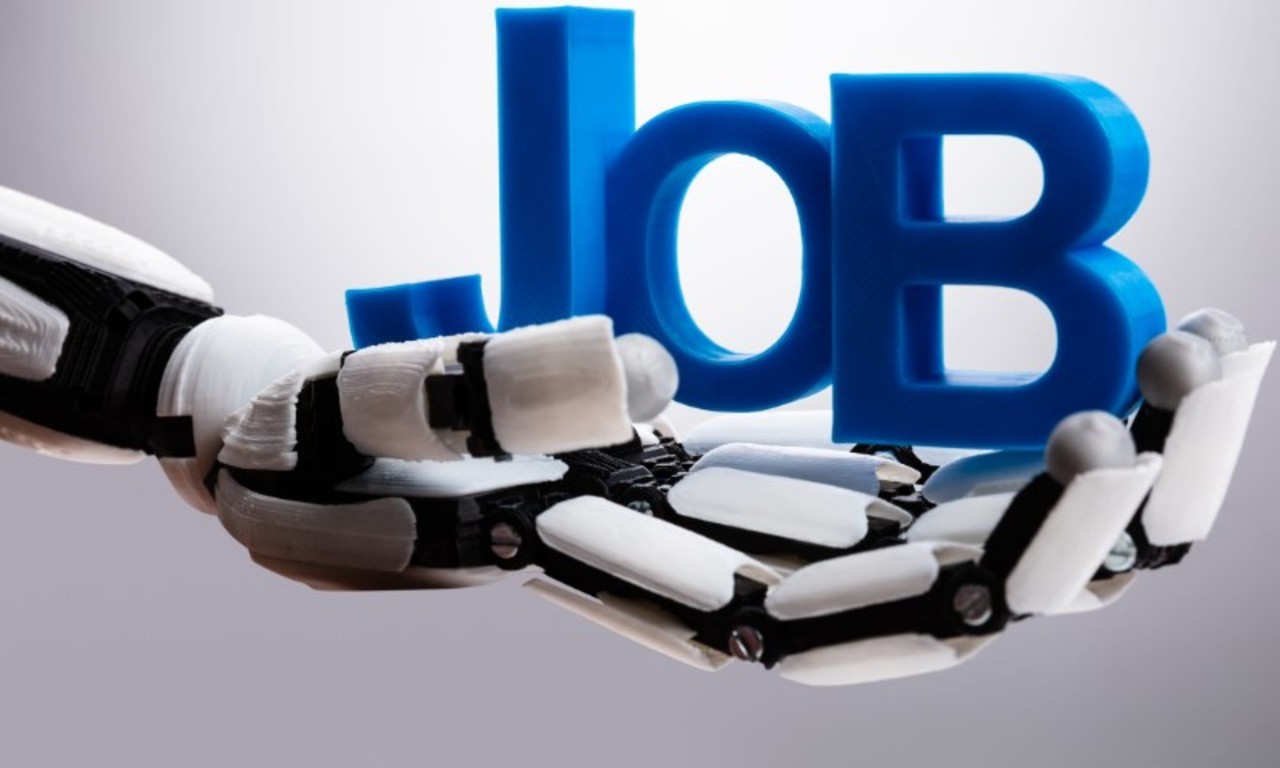
Artificial intelligence promises to make workers more productive, but Americans are increasingly convinced that companies will eventually need fewer of them.
A new survey finds that 71% of U.S. adults expect AI to reduce the number of jobs over the next 20 years, while just 5% expect it to create more.
Another 10% believe AI will make little difference to employment, leaving a remarkable 66-percentage-point gap between those expecting job losses and those anticipating job growth.
For every American expecting more jobs, roughly 14 expect fewer. Silicon Valley may be selling efficiency, but much of the public appears to be reading the fine print.
Americans Are Getting More Pessimistic, Not Less
View this post on Instagram
Back in August 2024, 64% of Americans believed AI would reduce employment opportunities over the following two decades. By June 2026, that figure had climbed to 71%.
That represents a 7-percentage-point increase, equivalent to a roughly 11% relative rise in the share expecting fewer jobs.
Seven percentage points might not sound particularly dramatic until you remember that nearly two-thirds of Americans were already predicting job losses two years earlier. AI did not exactly have an optimism problem to spare.
Meanwhile, expectations of job creation have barely moved. Just 5% anticipated more jobs in both surveys, while the share expecting little difference declined slightly, why?
For instance, chatbots can draft reports, software can summarize meetings, and automated systems can handle tasks that previously required human attention.
Automation is already playing a substantial role in the American workplace. A 2026 workforce study estimated that one in five U.S. jobs had at least half of its tasks automated, while 21% of employment involved using AI tools for at least half of its tasks.
Still, an interesting question emerges. Are Americans becoming more concerned because AI is improving, or because its growing capabilities make potential employment losses easier to imagine?
Frequent AI users are not necessarily the most reassured employees, either. Gallup research found that workers using AI daily or several times a week were generally more than twice as likely to fear imminent job elimination as those using it less frequently.
Younger Americans Are Not Particularly Reassured
Anyone expecting younger generations to enthusiastically embrace an AI-powered job market might want to reconsider.
Among Americans ages 18 to 34, 73% expect AI to reduce employment opportunities, compared with 67% of adults aged 50 and older.
That seven-percentage-point difference is particularly interesting because younger workers potentially face several decades of technological changes during their careers. Lower expectations among older adults are influenced substantially by people aged 65 and older.
Concern about AI more generally has also increased sharply among younger Americans.
In 2024, 40% of adults under 35 described themselves as more concerned than excited about AI in everyday life. By 2026, that figure had reached 55%, an increase of 15 percentage points.
Apparently, growing up alongside AI does not automatically make someone enthusiastic about competing with it for employment.
Entry-level positions could become an important part of that discussion. Employers might eventually automate some routine research, administrative duties, and basic content production that traditionally help inexperienced employees develop professional skills.
None of that establishes that younger workers are already losing opportunities on a large scale.
An August 2026 analysis of payroll records covering millions of American workers found that employment among people ages 22 to 25 in AI-exposed occupations was 19% below the level expected if it had followed trends among less-exposed workers.
Researchers found that much of the difference involved slower hiring rather than existing employees being dismissed.
In other words, AI might be affecting some careers before they properly begin. However, the findings do not establish that AI alone caused the employment gap.
America Is Near the Top of an Unfortunate Ranking

American concerns are hardly an isolated phenomenon, although the United States occupies a particularly uncomfortable position internationally.
Across 37 countries surveyed, Australia and South Korea recorded the highest shares expecting AI-related job losses, at 76% each. America followed at 71%.
By comparison, the international median was 46%, putting the United States 25 percentage points above the typical surveyed country.
Across 34 of the 37 countries, more respondents expected AI to eliminate jobs than create them.
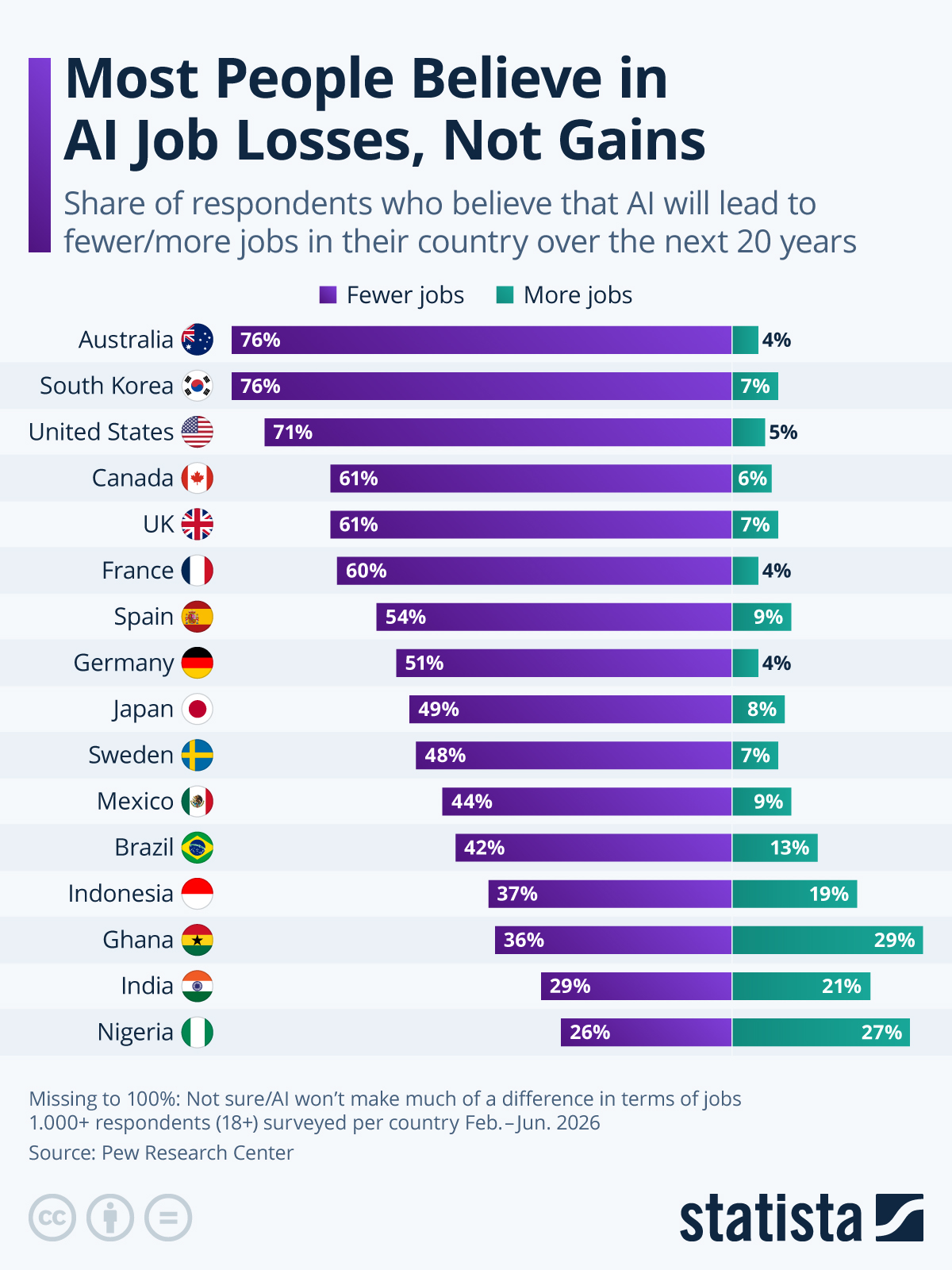
America has essentially secured a podium finish in AI job pessimism. Not exactly the sort of international ranking anyone is likely to put on a recruitment poster.
Americans Are Worried About More Than Unemployment

Job security is only one part of America’s increasingly complicated relationship with artificial intelligence.
In 2026, 52% of Americans said they were more concerned than excited about AI’s growing presence in everyday life. Another 37% felt equally concerned and excited, while just 9% expressed greater excitement.
Concern has increased substantially since 2021, when 37% reported feeling more worried than enthusiastic.
Economic inequality adds another uncomfortable dimension.
Around 46% of Americans believe AI will widen the gap between wealthy and poorer people, while just 5% expect it to narrow that gap.
Those figures raise an important question about how productivity gains might be distributed.
Imagine a company using AI to complete significantly more work with its existing employees.
That could increase profitability, support higher wages, or allow the business to expand.
Alternatively, management could decide that improved efficiency makes some positions unnecessary.
Both scenarios involve productivity improvements, but their consequences for workers are considerably different.
AI companies are understandably enthusiastic about generating more economic value. Employees may be slightly more interested in discovering how much of that value appears in their paychecks.
Predicting Job Losses Is Easier Than Proving Them
One distinction deserves particular attention. A survey measuring expectations about employment is not evidence that AI has already eliminated jobs on the same scale.
AI can affect employment in several ways, and those effects should not be treated as interchangeable.
Automating a task might allow an employee to complete assignments faster without threatening their position.
Productivity gains are already showing up in workers’ experiences. Federal Reserve research found that one in four American workers had used generative AI on the job during the previous month, with 81% of users reporting that it saved them time.
Saving time, however, is not the same as eliminating a position. An employee finishing an assignment faster might simply have more time for other responsibilities.
What happens next depends considerably more on management decisions than on the chatbot itself.
Consider a customer support department. AI might handle simple questions while employees manage complicated problems. A company could then expand its service capacity without additional hiring.
Another company might use identical technology to operate with a smaller workforce.
Neither outcome is guaranteed merely because the technology becomes available.
AI may also create occupations, business opportunities, and demand for specialized expertise.
A World Economic Forum report projected 170 million new jobs worldwide by 2030 alongside 92 million displaced positions, resulting in a net gain of 78 million.
Those projections account for several major economic changes, not simply artificial intelligence.
Another AI Problem Could Be Public Confidence
Continued improvements in AI could make employment concerns more prominent, particularly if businesses begin discussing automation as an alternative to additional hiring.
For employers, that creates a potentially awkward situation.
Technology introduced to improve productivity might also increase employee skepticism about management’s intentions. Recruitment, retraining programs, and workplace trust could all become more complicated.
Younger workers could become particularly sensitive to those decisions as they progress through their careers and encounter AI in an expanding number of occupations.
Public pressure could also increase demands for clearer corporate policies and government oversight of workplace automation.
None of those outcomes is inevitable.
Successful AI adoption could eventually create opportunities that improve public expectations. New industries, better wages, or stronger employment growth might provide evidence that current concerns are overstated.
Equally important, two survey observations cannot establish a reliable trajectory for the next several years. A seven-percentage-point increase between 2024 and 2026 does not mean pessimism will continue rising at the same pace.
An April 2026 report found that 18% of American employees believed new technologies could eliminate their jobs within five years. Among employees at organizations already using AI, the figure climbed to 23%.
AI’s Productivity Revolution Has a Trust Problem
Artificial intelligence could eventually create occupations and industries that barely exist today. It could also change how businesses operate without producing the widespread unemployment many Americans anticipate.
Right now, however, public confidence is moving in the opposite direction.
With 71% expecting fewer jobs over the next two decades, compared with 64% in 2024, Americans are becoming increasingly skeptical that AI’s economic benefits will translate into employment opportunities.
That expectation is not a forecast of what must happen. It does suggest that technology companies have an increasingly difficult argument to make.
AI has become remarkably good at demonstrating what it can do.
Convincing Americans that there will still be enough work for them to do might prove considerably harder.
Figures reflect the sources and time periods cited in this story. It is general information, not financial or investment advice.