T-Mobile’s 5G Downloads Now Run Almost 100 Mbps Ahead of the Next Carrier
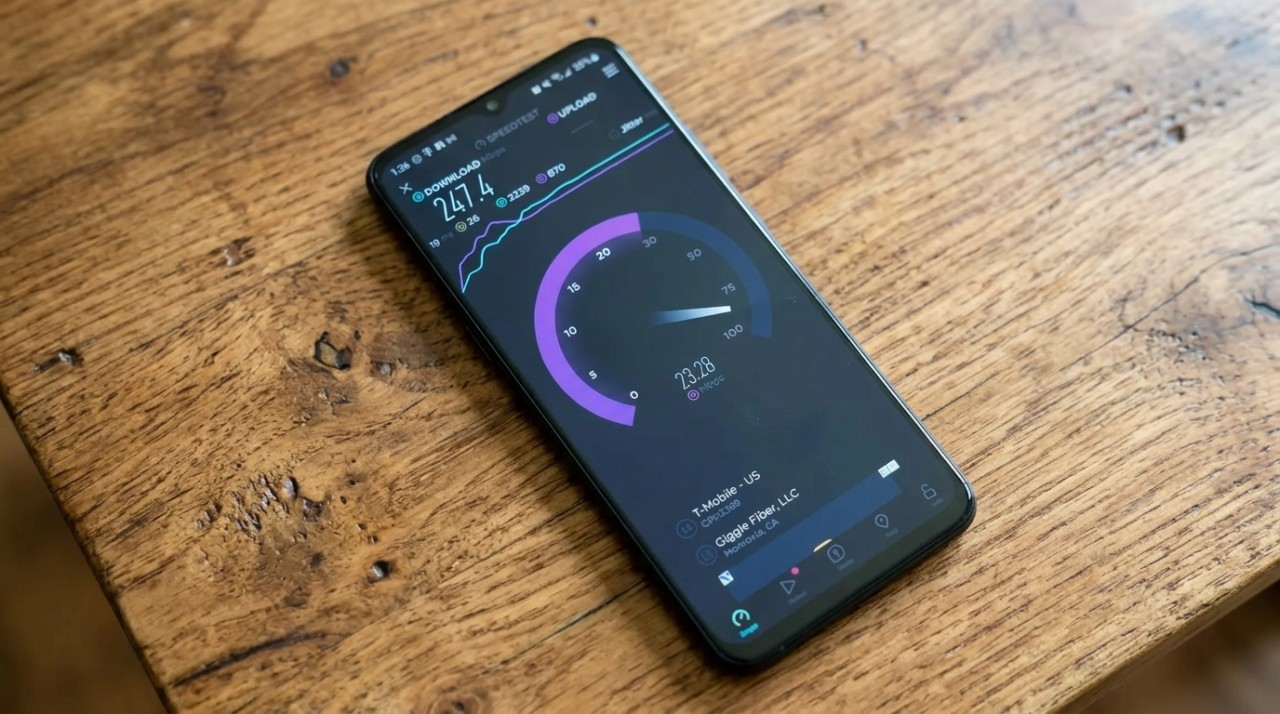
T-Mobile has apparently decided that beating its rivals in download speeds isn’t enough. It would rather nearly double its performance.
Average overall download speeds reached 192.5 Mbps on T-Mobile in Opensignal’s July 2026 report, compared with 96.0 Mbps on AT&T and 89.4 Mbps on Verizon.
That’s a 96.5 Mbps advantage over its closest competitor, putting T-Mobile at roughly twice AT&T’s average speed.
And speed was only part of the story.
T-Mobile collected 12 of 16 network performance awards, winning categories covering download speeds, uploads, reliability, and consistency.
Numbers like those make a convincing case for the fastest mobile network in America. But there’s another question worth asking.
Does being the fastest automatically make T-Mobile the best choice for everyone?
T-Mobile’s Download Speed Lead Is Hard to Ignore
Measurements collected between April 1 and June 29, 2026, revealed a substantial performance gap among America’s three major carriers.
| Carrier | Overall download | 5G download |
| T-Mobile | 192.5 Mbps | 247.4 Mbps |
| AT&T | 96.0 Mbps | 223.5 Mbps |
| Verizon | 89.4 Mbps | 179.2 Mbps |
One distinction matters here.
T-Mobile’s nearly 100 Mbps advantage concerns overall download speeds, which include connections using different network technologies.
Looking exclusively at 5G, its advantage over AT&T shrinks to 23.9 Mbps, or approximately 10.7%.
Suddenly, AT&T looks considerably more competitive.
Separate testing during the first half of 2026 also placed T-Mobile first, recording median download speeds of 275.55 Mbps overall and 314.38 Mbps on 5G.
Those results earned it Best Mobile Network and Best 5G Network distinctions.
Median speeds and average user-experience measurements aren’t interchangeable. Different testing methods, devices, locations, and statistical calculations help explain the gap between the reported figures.
Both assessments nevertheless identify the same speed leader.
T-Mobile also topped the upload rankings, reaching 16 Mbps overall and 19.2 Mbps on 5G.
And while T-Mobile is leading the competition, America’s mobile networks are collectively getting considerably faster.
RootMetrics testing found that combined nationwide download speeds across the three major carriers climbed approximately 74% between the first half of 2024 and the first half of 2026, increasing from around 192 Mbps to 334 Mbps.
Why Is T-Mobile So Much Faster?
Much of T-Mobile’s advantage can be traced to its extensive mid-band 5G spectrum holdings, strengthened considerably by its 2020 merger with Sprint.
Mid-band frequencies occupy a particularly useful position in wireless networking.
Low-band spectrum travels farther and penetrates buildings effectively but typically offers less capacity. High-band frequencies can deliver exceptional speeds, although their shorter reach limits their usefulness across large areas.
Mid-band offers a practical compromise: substantial capacity without requiring cell towers on practically every street corner.
Having more usable spectrum also helps carriers handle simultaneous connections, especially in crowded locations.
Another important figure is 91.8% 5G Availability, which T-Mobile achieved in July 2026.
That percentage measures how much time eligible users spend actively connected to 5G. It doesn’t mean T-Mobile geographically covers 91.8% of America.
T-Mobile won’t make your text messages arrive twice as fast. But downloading a massive game update? Suddenly, those extra megabits look rather useful.
Verizon and AT&T Still Have Reasons to Fight Back
Verizon may not have won the speed contest, but its coverage performance tells a different story.
Verizon scored 9.7 out of 10 for overall Coverage Experience, beating its competitors in a category that measures network availability across places people live, work, and travel.
T-Mobile, meanwhile, led the separate 5G Coverage Experience category with 8.5 points.
Verizon also secured victories in 5G Video Experience and 5G Live Video Experience, demonstrating that raw download speeds don’t determine every aspect of network performance.
AT&T brought another impressive number to the competition.
Its 99.6% Time on Network score indicated that participating users maintained a mobile network connection for nearly all their measured time.
AT&T also recorded the greatest improvements in download and upload performance, suggesting that today’s rankings shouldn’t be mistaken for permanent positions.
By November 2025, approximately 30 MHz of additional 3.45 GHz spectrum was already active on its network. Between July and November, the share of 5G tests using that frequency range, or C-band, increased by a combined seven percentage points.
More importantly, early testing identified improvements in peak 5G speeds.
T-Mobile may have the bigger lead today, but AT&T is acquiring some of the tools needed to make the next speed comparison considerably more interesting.
Does T-Mobile’s Speed Lead Actually Matter?
For demanding mobile activities, absolutely.
Large app installations, offline video downloads, mobile hotspots, and substantial file transfers can benefit directly from higher throughput.
Ordinary messaging, browsing, and streaming may produce far less noticeable differences once a connection is already fast enough.
Another measurement makes T-Mobile’s performance more interesting.
In July 2026, it achieved 82.8% Consistent Quality, compared with Verizon’s 80.4% and AT&T’s 79.4%.
Keeping those networks running smoothly is also becoming a bigger challenge.
Global mobile data traffic increased 23% between Q2 2025 and Q2 2026, exceeding 220 exabytes per month. North America was among the major contributors to that growth.
For carriers, that means increasing network capacity matters just as much as raising headline download speeds. A fast network today still needs enough room to handle tomorrow’s traffic.
A 2.4-percentage-point lead over Verizon isn’t nearly as dramatic as the overall download-speed advantage, but it suggests that T-Mobile’s performance extends past headline speed measurements.
Actual experiences still depend on local congestion, signal strength, devices, and potential restrictions imposed by individual mobile plans.
And competition may soon get more interesting. Starlink is emerging as a potential competitor to traditional wireless carriers, although satellite connectivity still has considerable catching up to do before it can challenge terrestrial 5G speeds.
T-Mobile has built a substantial advantage, particularly in overall download performance. Yet AT&T is improving, Verizon continues competing aggressively on coverage, and additional network capacity could change future results.
If current improvements continue, the next interesting question might not be how much faster T-Mobile can get.
It might be how quickly its competitors can catch up.
Figures reflect the sources and time periods cited in this story. It is general information, not financial or investment advice.